
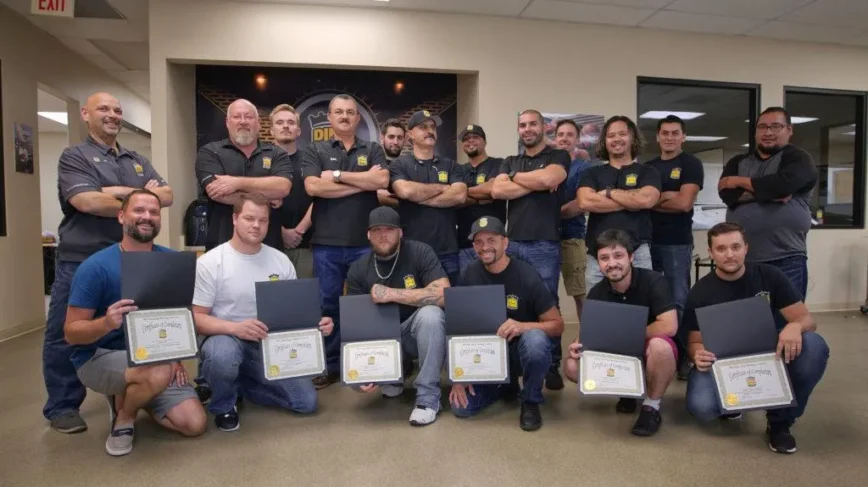
What It Means to Be Truly “Certified” in Paintless Dent Repair Training
At Certified-PaintlessDentRepairTraining.com, certification is more than a document or a completion badge. It is a demonstration of knowledge, skill, judgment, and consistency. Paintless Dent Repair (PDR) is a craft of precision, control, and patience. The difference between a trained technician and a certified technician is the ability to produce results reliably — not just once, but every day. Certification verifies that a technician can read panel reflection correctly, select appropriate access and tool paths, use controlled pressure, and complete repairs that are clean, smooth, and undetectable. True certification reflects competence that can be trusted.
PDR is a hands-on discipline that requires repeatable accuracy. While anyone can watch a video or attempt a repair, the industry recognizes certified technicians as professionals who understand not only how to remove dents, but why each movement matters. Certification gives technicians the credibility to work with dealerships, insurance networks, collision centers, rental companies, and wholesale reconditioning departments. It demonstrates that repairs are performed with respect for the factory finish, proper metal movement, and clean final reflection.
“Certification isn’t about proving you finished training. It’s about proving you earned mastery.”
What Certification Represents
When a technician becomes certified, it means they have demonstrated the ability to:
-
Identify and interpret reflection distortion with clarity
-
Access panels safely and effectively without damage
-
Apply controlled pressure through the correct tool and tip selection
-
Complete repairs to an invisible finish under multiple light conditions
Certification also verifies that the technician understands repair planning, time management, and professional work standards.
Why Certification Matters in Today’s Automotive Market
Dealerships and insurance companies increasingly rely on certified PDR technicians because the value of the repair depends on preserving original factory paint. Repainting lowers vehicle value. Fillers and sanding destroy the original surface. Certified PDR is the industry’s recognized solution for preservation-based repair. Certified technicians maintain the value, condition, and authenticity of the vehicle without altering its original paint surface.
Certification is the difference between being able to repair a dent and being trusted to do so.
The Certification Process
| Stage | Focus | Skill Demonstrated | Outcome |
|---|---|---|---|
| Foundational Training | Learning reflection and surface structure | Visual interpretation | Ability to locate and map dents |
| Technique Development | Pressure control and tool stability | Consistency | Ability to perform clean metal movement |
| Real Dent Application | Working on actual vehicle panels | Problem solving | Ability to adapt technique to variable conditions |
| Certification Evaluation | Performance testing and repair finishing | Precision under supervision | Recognition of professional-level competency |
Certification is earned through performance, not attendance.
Confidence Through Capability
Technicians gain confidence as they begin to control the outcome of each repair with precision. The most important progression is not speed — it is consistency. The certified technician can complete repairs without force, without guesswork, and without “hoping it turns out right.” Confidence comes from experience, but certification organizes that experience into measurable milestones.
The skill becomes both mental and physical — thought guides movement, and movement shapes the result.
Certification and Career Opportunity
Certified PDR technicians have multiple career pathways available to them. The skill is portable, scalable, and in demand across multiple sectors. A certified technician may choose to work independently, join a dealership rotation, operate a mobile service, travel during hail seasons, or build a reconditioning company. Certification supports each path because it represents professional trustworthiness.
Certification signals that the technician is ready to perform repairs at a professional and profitable standard.
Key Takeaways
Certification demonstrates reliable and repeatable PDR skill, not just participation in training.
Certified technicians preserve factory paint and vehicle value through proper repair technique.
Certification increases professional credibility and opens multiple career pathways.
Mastery is demonstrated when precision becomes consistent across varying repair conditions.
FAQs
Q: Do I need automotive experience to become certified?
No. Many certified technicians begin without industry background; the training builds skill step-by-step.
Q: How long does certification take?
Progress depends on practice frequency and commitment. Some technicians progress quickly while others develop skill over time.
Q: Is certification recognized by dealerships and insurance networks?
Yes. Certification is a key factor in earning professional contracts and work relationships.
Conclusion
Becoming certified in Paintless Dent Repair is not just about learning a technique — it is about mastering a repeatable skill that preserves vehicle value and reflects professional craftsmanship. Certification represents confidence, accuracy, and the ability to produce results without compromise. At its core, certification is a commitment to quality, responsibility, and the pride of knowing your work meets the highest standards in the industry.
